

Quick answer: Unani medicine is a traditional health system that began in ancient Greece and grew in Arab, Persian and Indian lands. It sees health as a balance of four body fluids, called humours. Care uses diet, daily habits, herbal medicines and hands-on therapies. Research is limited, so use it with a qualified doctor’s advice.
Key takeaways
- “Unani” comes from Yunani, the Arabic and Persian word for “Greek”.
- The system rests on four humours, a personal temperament (Mizaj) and six daily-life factors.
- Care has four parts: daily regimen, diet, medicines and, rarely, surgery.
- In India it is an AYUSH system with its own degree (BUMS), pharmacopoeia and research council.
- Modern research is limited. Natural does not mean risk-free, so quality and a qualified Hakim matter.
Written by Bioqem Pharma editorial team. Last updated: 10 October 2026.
What is Unani medicine?
Unani medicine is a Greco-Arabic system of health care. Today it is practised mainly in South Asia. The word “Unani” comes from Yunani, which means “Greek” in Arabic and Persian. The system is also called Tibb, the Arabic word for medicine.
It looks at the whole person, not just one complaint. A Hakim (Unani doctor) asks about your food, sleep, work, mood and body type. Then the aim is to restore balance. The Delhi government’s AYUSH department says Unani puts great weight on staying healthy and preventing disease.
In India the government counts Unani as one of the AYUSH systems. That short name stands for Ayurveda, Yoga and Naturopathy, Unani, Siddha and Homoeopathy.
Unani at a glance
| Word meaning | From Yunani, “Greek” |
| Also called | Tibb (medicine) |
| Roots | Greece, then Arab and Persian lands, then India |
| Core idea | Health is a balance of four humours and your Mizaj |
| Care methods | Daily regimen, diet, medicines, surgery |
| In India | AYUSH system, BUMS degree, CCRUM research council |
| Evidence | Limited modern research |
Where did Unani medicine come from?
It began with the ancient Greeks. The Delhi AYUSH department credits Hippocrates (about 460 BC), known as the “Father of Medicine”, with laying its base. The Greek physician Galen built on his ideas later.
Arab and Persian scholars then refined the system and wrote it down. Al-Razi and Ibn Sina (Avicenna) are two of the best known. Britannica says Arab scholars improved it through careful testing.
Unani reached India around the 11th to 12th century. It grew under the Delhi Sultanate and the Mughal rulers. In the 1920s Hakim Ajmal Khan (1868 to 1927) backed research and resisted a British plan to ban Indian systems of medicine.
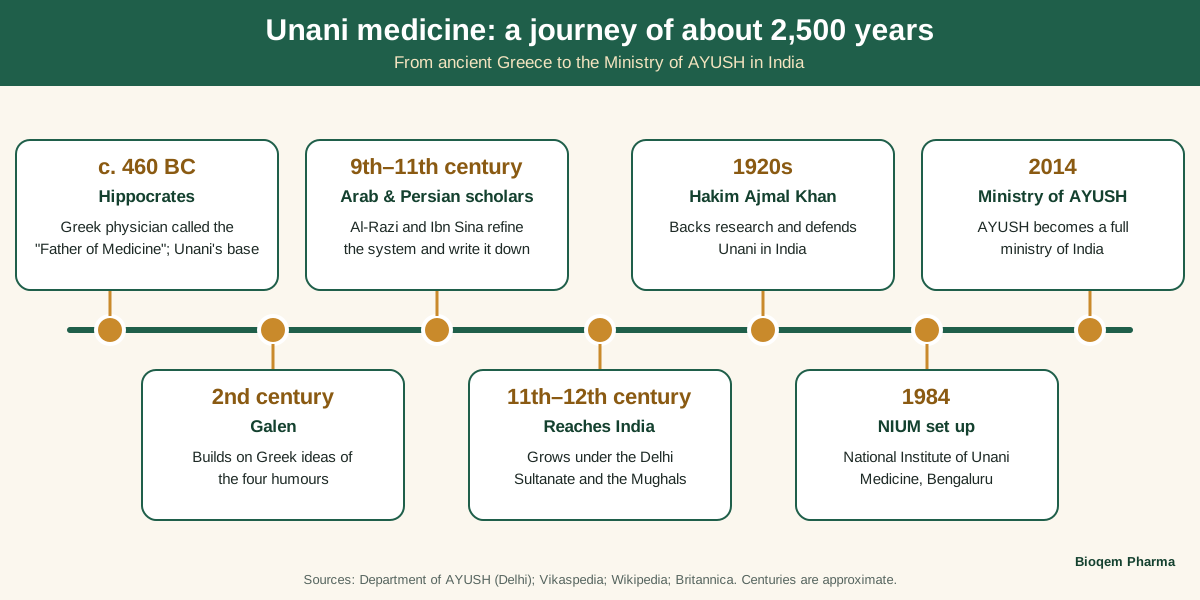
Today India has a full set-up around it. There is a degree course (BUMS) and a research council (CCRUM). There is also a national institute (NIUM in Bengaluru) and drug rules under the Drugs and Cosmetics Act, 1940.
How does the Unani system of medicine see the body?
The Unani system of medicine says the body runs on seven natural principles, called Umoor-e-Tabiya. They cover the elements, your temperament (Mizaj), the humours (Akhlat), the organs, the vital spirit, the body’s powers and its functions.
What are the four humours?
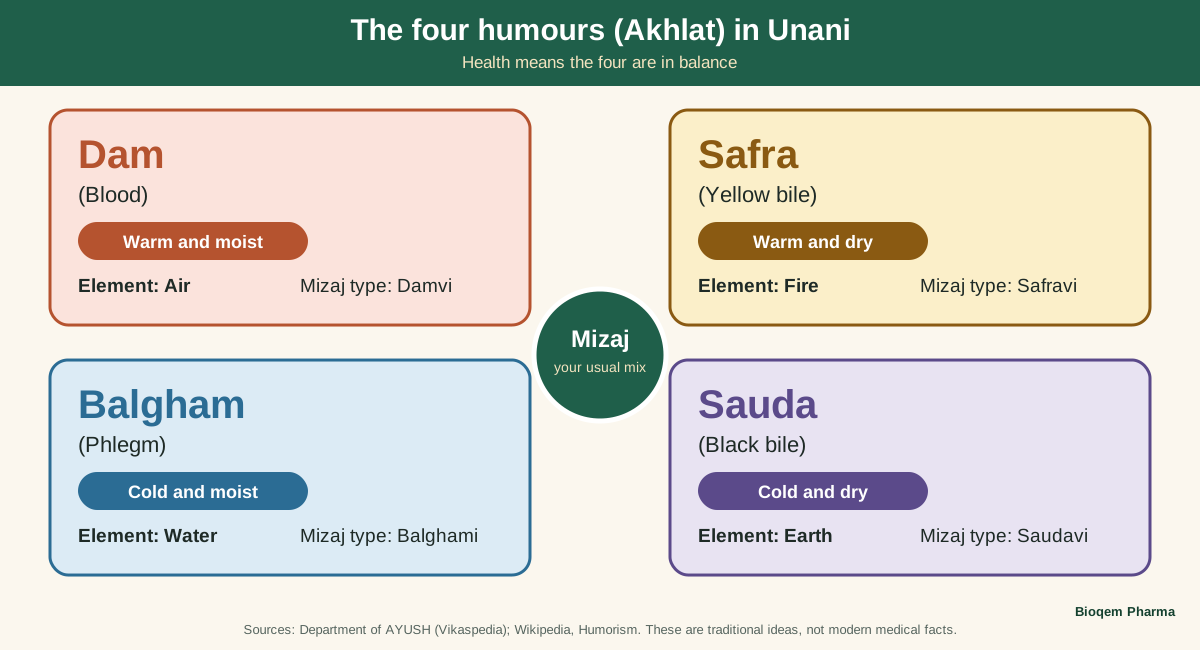
Humours (Akhlat) are four fluids that Unani believes feed and run the body. They are Dam (blood), Balgham (phlegm), Safra (yellow bile) and Sauda (black bile). Health means the four are in balance.
These are old Greek ideas. Modern medicine does not use them to explain disease. Read this part as history and tradition.
What is Mizaj (temperament)?
Mizaj is your body’s usual mix of warm, cold, moist and dry qualities. Unani says every person has a different Mizaj. So two people with the same complaint may get different advice. A Hakim also thinks about your surroundings and habits.
What are the six daily-life factors?
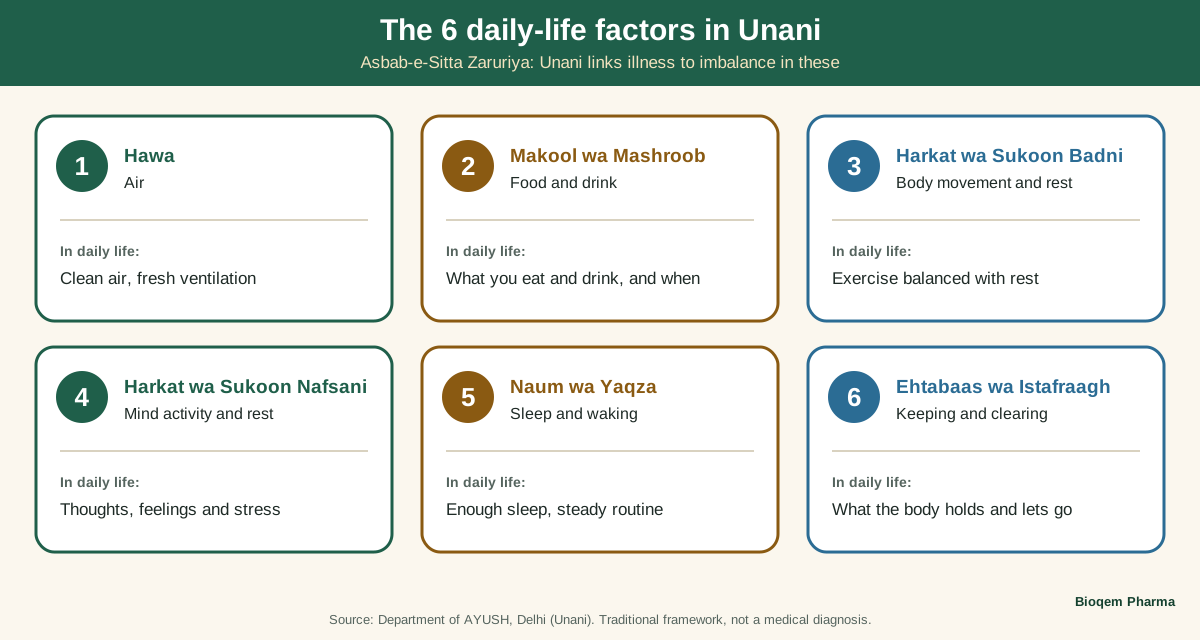
Unani names six factors that shape health every day. They are air, food and drink, body movement and rest, mind activity and rest, sleep and waking, and what the body keeps and clears. The Delhi AYUSH page says disease comes from imbalance in these.
Picture a college student who studies late, skips meals and sleeps at 3 a.m. A Hakim would look first at sleep, food and mental load. Or take an office worker who sits for ten hours. Here the first question is body movement and rest.
What do the six factors look like in a normal day?
- Air: open a window and spend time outdoors. Avoid smoky rooms.
- Food and drink: eat at regular times, drink enough water and go easy on fried and sugary food.
- Body: walk or stretch every day, and rest after hard work.
- Mind: take short breaks. Talk to someone you trust when you feel worried.
- Sleep: keep a fixed sleep and wake time. Put screens away before bed.
- Clearing: eat fibre and drink water. Do not hold back urine or stool.
These are general healthy habits. They are not a treatment plan for any illness.
How does Unani treatment work?
Unani treatment starts with a talk and a physical check. Then the Hakim picks one or more of four methods.
How does a Hakim check you?
A Hakim studies your Nabz (pulse), Baul (urine) and Baraz (stool). The AYUSH page says doctors depend mainly on these three. They also ask about habits, work and surroundings, and they think about your Mizaj.
What happens at a first visit?
Expect a long talk first. The Hakim asks about your complaint, food, sleep, work and past illness. Next comes the pulse, and sometimes a urine or stool check. Then you get a plan that may mix diet, daily routine and medicines. A good Hakim will also explain what to watch for and when to come back.
What are the four modes of Unani treatment?
- Ilaj-bil-Tadbeer (regimental therapy): routine and hands-on therapies. Examples are cupping (Hijama), massage (Dalk), exercise and the Turkish bath (Hammam).
- Ilaj-bil-Ghiza (diet therapy): food chosen for your Mizaj and health.
- Ilaj-bil-Dawa (medicines): drugs from plants, minerals and animals.
- Ilaj-bil-Yad (surgery): also called Jarahat. The AYUSH page says it is of very limited use.
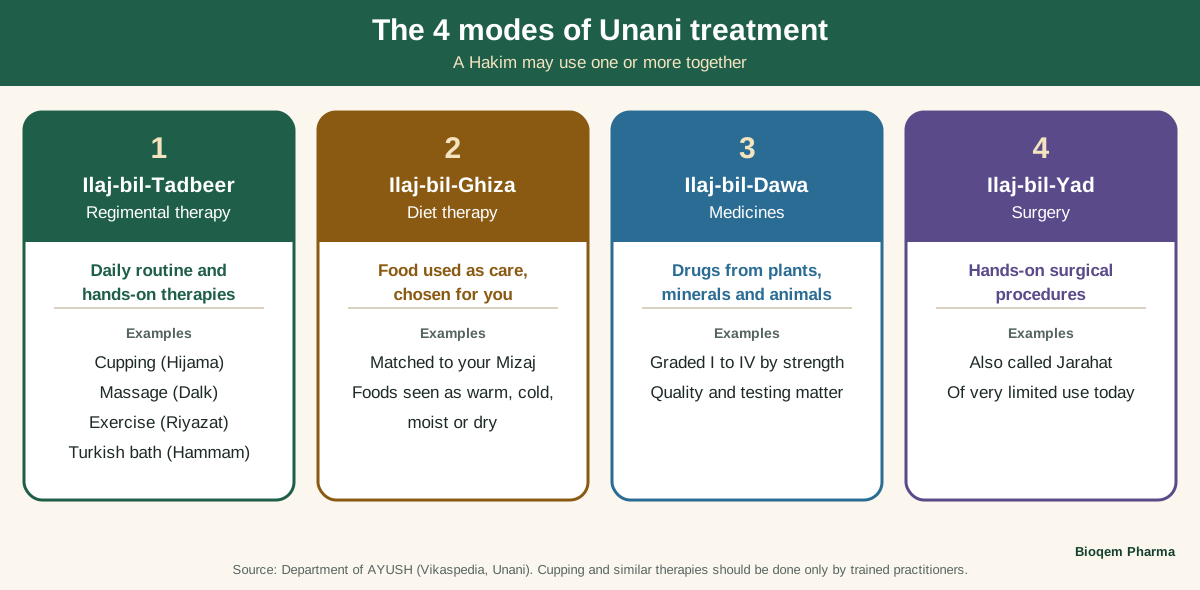
Some regimental therapies, such as cupping, are not risk-free. Only a trained, registered practitioner should do them.
What do people use Unani for?
Unani medicine uses herbs, minerals and animal-based drugs, along with diet and daily routine. People traditionally turn to it for joint comfort, digestion, skin care and general wellbeing.
How common is it? A small 2021 survey of 100 adults in East Delhi found that 67 had heard of Unani. Of those 67, 38 had used it. Users most often named bone and joint problems, then stomach and gut problems, then lifestyle conditions. The authors say few studies on Unani use exist in India.
These uses are traditional. “Traditionally used for” does not mean proven. Nothing on this page says that Unani medicine will fix a disease.
Is Unani medicine safe, and what does research say?
It can be safe when a product is well made, tested and used under a qualified doctor. But long use is not the same as proof. Modern science does not back the humour theory, and strong trials on Unani medicine are few.
Quality is the biggest worry. A research paper on a Unani tablet says herbal products can be adulterated. It also says heavy metals and pesticides can be a real danger, so standard tests are needed.
India has rules to help. Unani drugs come under the Drugs and Cosmetics Act, 1940. According to the Department of AYUSH, the Unani Pharmacopoeia of India has 298 monographs, and the national formulary lists 1,091 formulations.
Simple safety steps:
- Tell every doctor about all the herbs and medicines you take.
- If you are pregnant or breastfeeding, ask a qualified doctor first. Never give a herbal product to a child on your own.
- If you take regular medicines for blood sugar, blood pressure or blood thinning, never stop or swap them without your doctor.
- Check the pack for a licence number, batch number, ingredient list and expiry date.
- Stop and call a doctor if you get a rash, swelling, vomiting or unusual weakness.
Unani vs Ayurveda: what is the difference?
Both are old, whole-person systems. Both use herbs, diet and lifestyle. They differ in origin and in how they explain the body. For the Indian side of the story, read our guide on the history of Ayurveda.
| Point | Unani | Ayurveda |
|---|---|---|
| Origin | Greece, then Arab and Persian lands, then India | Indian subcontinent |
| Body model | Four humours: blood, phlegm, yellow bile, black bile | Three doshas: Vata, Pitta, Kapha |
| Classic texts | Works such as Ibn Sina’s Canon of Medicine | Charaka Samhita, Sushruta Samhita |
| University degree | BUMS | BAMS |
| Regulation in India | AYUSH ministry, NCISM | AYUSH ministry, NCISM |
Common myths about Unani
| Myth | Fact |
|---|---|
| Unani is only herbs. | It has four modes, including diet and daily regimen. |
| Unani and Ayurveda are the same. | Origin, theory and texts differ, though both aim at balance. |
| Natural means risk-free. | Herbal products can be contaminated or clash with medicines. |
| There are no rules for it in India. | The Drugs and Cosmetics Act, a pharmacopoeia and a degree course apply. |
| Anyone who sells herbs is a Hakim. | A qualified Hakim holds a recognised degree and registration. |
| It can replace tests and modern medicine. | Research is limited. Use it with, not instead of, modern care for serious illness. |
Who is a Hakim, and when should you see a doctor?
A Hakim is a trained Unani doctor. The main degree in India is the BUMS (Bachelor of Unani Medicine and Surgery). It is a course of about five and a half years, with a one-year internship. The National Commission for Indian System of Medicine (NCISM) sets the standards.
Questions to ask before you start any care:
- What is your degree, and may I see your registration?
- What is in this medicine, and who makes it?
- How long should I take it, and what should I watch for?
- Could it clash with my regular medicines?
- Do I need a blood test or a check-up first?
- When should I stop and see another doctor?
See a doctor soon if:
- symptoms last for weeks without getting better, or keep coming back
- you have diabetes, high blood pressure, heart disease or another long-term condition
- you are pregnant or breastfeeding, or the patient is a child
- you have a reaction after any herb, such as a rash, swelling or vomiting
- you notice unexplained weight loss, blood in stool or urine, or a new lump
Get urgent care for chest pain, trouble breathing, fainting, sudden weakness on one side of the body, or heavy bleeding.
Frequently asked questions
What does Unani mean?
Unani comes from Yunani, the Arabic and Persian word for Greek. It points to the Greek roots of the system. People also call it Tibb, which means medicine.
What is the full form of Unani?
Unani has no full form. It is not an acronym. It is a word that means “Greek”.
Who is the father of Unani medicine?
Hippocrates is the name most often given. The Delhi AYUSH page credits him with its base, about 460 BC. Galen, Al-Razi and Ibn Sina shaped it later. Hakim Ajmal Khan is respected for protecting it in India.
Is Unani medicine safe?
It can be, when a product is well made, tested and used under a qualified doctor. Natural does not mean risk-free. Take extra care in pregnancy, with children and with regular medicines.
Does Unani medicine have side effects?
Yes, it can. Any herbal or mineral-based product may cause a reaction in some people, or clash with other medicines. Poor-quality products add more risk, so stop and see a doctor if you feel unwell after using one.
Is Unani medicine effective?
Research is limited. Unani has a long tradition, but strong modern trials are few. Be careful with any promise of sure results. Use it alongside, not instead of, modern care for serious illness.
Who is a Unani doctor?
A Unani doctor, called a Hakim, is trained in this system. In India that usually means a BUMS degree and registration. Always ask to see the registration.
What is the difference between Unani and Ayurveda?
Unani began in Greece and the Arab world, and uses four humours. Ayurveda began in India and uses three doshas. Both use herbs, diet and lifestyle to seek balance.
Sources
- Unani, Department of AYUSH, Government of NCT of Delhi
- Unani, Vikaspedia (Department of AYUSH content)
- Unani, Encyclopaedia Britannica
- Unani, Wikipedia
- Awareness and use of Unani in East Delhi, Journal of Pharmacy and Bioallied Sciences, 2022
- Standardization of a Unani polyherbal tablet, Journal of Pharmacy and Bioallied Sciences, 2015
Read next
- History of Ayurveda: Origin, Timeline and Key Texts
- If you want to see our range, take a look at our range of Unani tonics.
This article is for general education only. It is not medical advice and does not diagnose, treat, cure or prevent any disease. Please talk to a qualified doctor before you change your diet, routine or medicines.