
Quick answer
You can often increase sperm count naturally by reaching a healthy weight, stopping smoking and tobacco, cutting alcohol, keeping the testicles cool, sleeping 7 to 8 hours, exercising regularly and eating whole foods. Sperm take about 2.5 to 3 months to develop, so give any change at least 3 months. If you have tried for a year without a pregnancy, get a semen test and see a doctor.
If you are reading this, you may be planning a baby, or a semen report has just told you your count is “low”. Either way, the good news is real: how to increase sperm count is a question with some clear, evidence-based answers. Many of them are free.
This guide is written for Indian men. It explains what sperm count means, what lowers it, 12 habits that help, what a normal report looks like, which supplements have some evidence, and when a doctor should step in. We have also added a simple 90-day plan, because that is roughly how long your body needs to make new sperm.
Key takeaways
- Weight, smoking, alcohol, heat, sleep and stress affect sperm count the most. You can change all of them.
- Sperm take about 2.5 to 3 months to mature, so judge results after 3 months, not 3 days.
- The WHO lower reference for sperm concentration is 16 million per ml.
- Testosterone injections or gym “boosters” can push sperm count down sharply.
- Get a semen test if you have tried for 12 months (6 months if your partner is 36 or older).
✍️ Written by: Bioqem Pharma editorial team | 🩺 Medically reviewed by: Dr Danish Farhan (BUMS) | 📅 Last reviewed: 28 November 2026
In this article
What is sperm count, and why does it matter?
Sperm count is the number of sperm in one sample of semen. Labs report it in two ways: how many million sperm are in each millilitre (concentration), and how many are in the whole sample (total count). More sperm means more chances that one of them reaches the egg.
But count is only one part of the story. Sperm also need to move well (motility) and have a normal shape (morphology). Mayo Clinic explains that sperm health depends mainly on quantity, movement and shape. So a man with a “normal” count can still have trouble if most sperm do not move, and a man with a lowish count can still become a father.
There is also a bigger picture. a 2022 global review in Human Reproduction Update found that sperm counts around the world have fallen sharply over the past few decades, including in Asia, and the fall has been faster after 2000. Researchers link this to modern lifestyle and environment, which is exactly the part you can work on.
Can sperm count be increased?
Yes, in many men it can. If your count is low because of lifestyle, such as extra weight, smoking, heavy drinking, heat or poor sleep, fixing these often improves it. If the cause is medical, like a blocked tube, a hormone problem, a varicocele (swollen veins in the scrotum) or a genetic issue, you will need a doctor’s treatment, and lifestyle changes help as a support.
Timing matters. Cleveland Clinic notes that results usually take at least three months, because that is the length of the sperm life cycle. Anyone who promises to raise your count “in 7 days” is not telling you the truth.
What lowers sperm count? Common causes
Before looking at how to increase sperm count in men, it helps to know what pulls it down. Here are the most common reasons. Most men have more than one.
| Cause | How it affects sperm | Can you change it? |
|---|---|---|
| Extra weight and belly fat | Changes hormones and raises heat around the testicles | Yes |
| Smoking, gutka, khaini | Tobacco chemicals lower count and movement and damage sperm DNA | Yes |
| Regular alcohol | Lowers semen production and quality | Yes |
| Heat (laptop on lap, saunas, hot tubs) | Testicles need to stay cooler than the body | Yes |
| Poor sleep and night shifts | Disturbs hormones | Partly |
| Long-term stress | Disturbs the hormones that make sperm | Partly |
| Testosterone injections or steroid “boosters” | Tell the brain to stop the signals that make sperm | Yes, stop with a doctor’s help |
| Infections (STIs, mumps after puberty) | Can block tubes or damage testicles | Treatable in many cases |
| Varicocele, hormone or genetic problems | Affect sperm production directly | Needs a doctor |
| Some medicines and cancer treatment | Can lower production | Talk to your doctor |
Low sperm count signs: how do you know?
Most men with a low sperm count feel completely normal. According to the NHS, the main sign is difficulty getting your partner pregnant. Some men also notice:
- Pain, swelling or a lump in the testicles
- Low sex drive or trouble getting an erection
- Less facial or body hair, or other signs of low hormones
- Very small amount of semen each time
None of these prove a low count. Only a semen test can tell you. Watery semen once in a while is usually not a sign of anything, so do not panic over one observation.
How to increase sperm count naturally: 12 habits that help
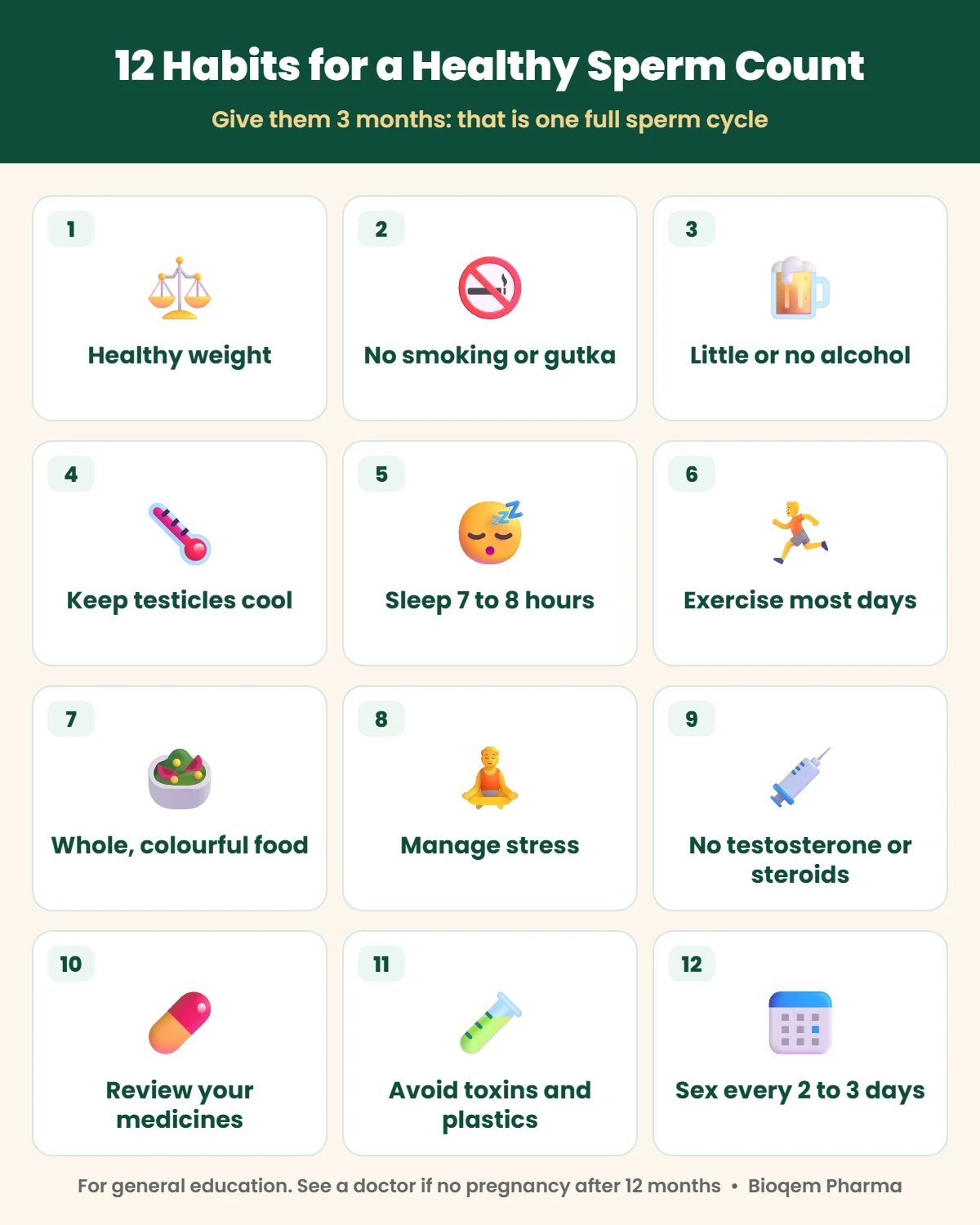
If you want to know how to improve sperm count without medicines, these are the habits with the best support from research and doctors. Start with the ones that apply to you. You do not need to be perfect; steady changes over 3 months matter more.
1. Reach a healthy weight
Extra weight is one of the biggest things you can fix. Cleveland Clinic reports that infertility risk rises by about 10% for every 20 pounds (about 9 kg) of excess weight. Losing even a few kilos through food and exercise can help your hormones.
2. Stop smoking and chewing tobacco
Tobacco chemicals lower sperm count and movement and also damage the DNA inside sperm. This includes cigarettes, bidis, gutka and khaini. Quitting is one of the most powerful steps you can take.
3. Cut down on alcohol
Cleveland Clinic notes that more than seven drinks a week can reduce semen production and sperm quality. If you are trying for a baby, the safest choice is to drink very little or not at all.
4. Keep your testicles cool
Sperm are made best at a temperature a little lower than the rest of the body. Avoid hot tubs and saunas, do not keep a laptop on your lap for long, and take short breaks if you sit for many hours. Choose loose, breathable clothes in hot weather.
5. Sleep 7 to 8 hours
Sleep resets your hormones. Cleveland Clinic says to aim for 7 to 8 hours, and links less than 6 hours of sleep with a more than 40% lower chance of conception. Very long sleep (over 9 hours) was also linked with poorer sperm health.
6. Exercise regularly, but do not overdo it
Moderate exercise, like brisk walking, cycling, swimming or strength training, 30 to 45 minutes on most days, supports weight, hormones and mood. Extreme endurance training without rest can do the opposite.
7. Eat whole, colourful food
A balanced diet with vegetables, fruits, whole grains, dals, nuts, seeds, curd and fish or eggs gives your body zinc, folate, antioxidants and healthy fats. Cut down on fried snacks, sweets and packaged food. A Mediterranean-style diet is the one most studied for sperm health.
8. Manage stress
Stress hormones can lower the hormones that make sperm. Simple daily habits help: a 20-minute walk, breathing exercises, yoga, talking to someone you trust, and limiting late-night screen time.
9. Never take testosterone without a fertility check
This surprises many men. Cleveland Clinic warns that taking testosterone to boost fertility backfires, because it switches off your natural sperm production. The same applies to anabolic steroids and some gym “testo boosters”. If you take any of these, tell your doctor before stopping them.
10. Review your medicines
Some medicines can lower sperm production. Do not stop any prescribed medicine on your own, but ask your doctor whether anything you take could affect fertility.
11. Avoid toxins at home and work
Pesticides, heavy metals, paint fumes and some plastics may harm sperm. Use gloves and masks at work, store food in steel or glass, and avoid heating food in plastic containers.
12. Have sex at the right time
For couples trying to conceive, the NHS suggests having sex every 2 to 3 days. This keeps sperm fresh without needing to track exact dates. Holding back for many days does not make sperm “stronger”.
How long does it take to increase sperm count?
Your body makes new sperm all the time, but each batch takes about 2.5 to 3 months to fully mature. This is why doctors ask you to repeat a semen test after about 3 months of changes. So if you are searching for how to increase my sperm count fast, the honest answer is: there is no overnight fix, but 90 days of good habits can make a real difference.
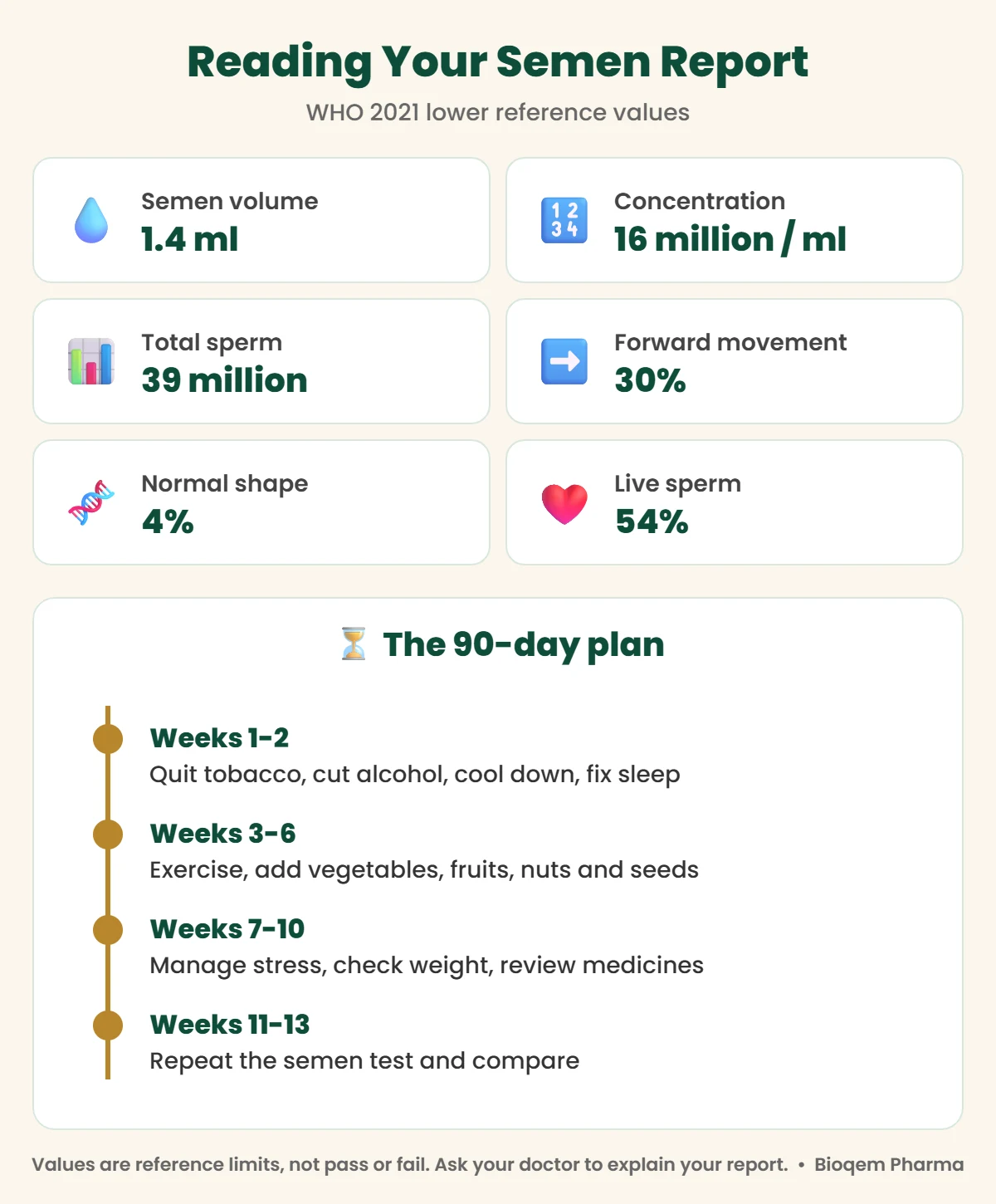
A simple 90-day plan
| Weeks | What to focus on |
|---|---|
| Weeks 1 to 2 | Stop smoking and tobacco, cut alcohol, move the laptop off your lap, fix your sleep time. |
| Weeks 3 to 6 | Start regular exercise, add vegetables, fruits, nuts and seeds to every day, reduce junk food. |
| Weeks 7 to 10 | Keep going; work on stress, check your weight, review medicines and supplements with a doctor. |
| Weeks 11 to 13 | Repeat your semen test and compare with the first report. |
Foods that support sperm health
No single food will “produce sperm fast”, but some foods give your body what it needs to make healthy sperm. Try to include these often:
| Food | What it gives |
|---|---|
| Pumpkin seeds, sesame seeds, chana | Zinc |
| Walnuts, flaxseed (alsi), fish | Omega-3 healthy fats |
| Spinach, methi, other leafy greens, dals | Folate |
| Amla, guava, oranges, tomatoes | Vitamin C and antioxidants |
| Eggs, curd, paneer, dals | Protein |
| Bananas, pomegranate, berries | Antioxidants and energy |
Equally important is what you eat less of: deep-fried food, sugary drinks, very processed snacks and too much red or processed meat.
Do supplements, tablets or herbs increase sperm count?
Many people search for how to increase sperm count tablet options. Here is the honest picture:
- Vitamins and minerals: zinc, folate, vitamin D, CoQ10 and antioxidants may help men who are low in them. Results in studies are mixed, so ask your doctor to check before you buy.
- Ashwagandha: in a small 2013 Indian trial, 46 men with low sperm counts took ashwagandha root extract or a placebo for 90 days. The ashwagandha group showed a 167% rise in sperm count. a 2018 review of ashwagandha studies found similar improvements, but most studies were small, so more research is needed. Read more about ashwagandha.
- Other Ayurvedic herbs: safed musli, shilajit, kaunch beej and gokshura are traditionally used for men’s vitality. Human research on sperm count is limited.
- “Sperm badhane ki dawa” sold online: be careful with products that promise fast results, have no licence number, or come without a lab report. Some have been found to contain hidden steroids.
Always choose licensed products, follow the label or your doctor’s advice, and remember that herbs work best alongside the habits above, not instead of them.
How to increase testosterone and sperm count together
Testosterone and sperm are linked, but the link is often misunderstood. Your own testosterone, made inside the testicles, helps make sperm. Testosterone from outside, such as injections, gels or steroids, does the opposite: it tells the brain to stop the signals that make sperm.
So the safe way to support both is natural: lose extra weight, sleep well, do strength training, manage stress and get enough zinc and vitamin D. If tests show truly low testosterone, a doctor may use treatments that protect fertility.
Sperm count and age: what changes over time?
Men make sperm all their lives, but quality changes with age. Mayo Clinic notes that sperm movement and the number of normally shaped sperm tend to go down with age, especially after 50.
| Age | What usually happens |
|---|---|
| 20s | Usually the best sperm quality; lifestyle has the biggest effect. |
| 30s | Small, slow decline begins; weight gain and stress often start to matter. |
| 40s | Movement and shape decline further; it may take longer to conceive. |
| 50 and above | Clearer drop in motility and normal shape; a doctor’s check is worth doing before planning. |
What is a normal sperm count? Reading your semen report
Doctors in India use the World Health Organization (WHO) 2021 values. The numbers below are the lower reference limits, taken from WHO 2021 reference values (as published by NHS Manchester). Values above these are generally considered within the normal range.
| Semen test item | WHO 2021 lower reference value |
|---|---|
| Semen volume | 1.4 ml |
| Sperm concentration | 16 million per ml |
| Total sperm number | 39 million per sample |
| Progressive motility (moving forward) | 30% |
| Normal shape (morphology) | 4% |
| Vitality (live sperm) | 54% |
| pH | 7.2 or more |
Remember: these are reference values, not a pass or fail mark. Many men below them still father children, and one report is not enough to judge. Doctors usually repeat the test.
How to check sperm count: lab test vs home kit
The best test is a semen analysis at a good lab. You usually avoid ejaculation for 2 to 5 days before the test, collect the sample at the lab or bring it within an hour, and keep it at body temperature.
Home sperm count kits are easy to use, but most only check concentration, not movement or shape. They can give false comfort or false worry. Use them only as a rough first look, and get a proper lab test if you are planning a pregnancy.
My sperm count is zero. Can it be increased?
A report showing no sperm (called azoospermia) is upsetting, but it is not the end of the road. First, the test should be repeated. Then a doctor will check whether sperm are being made but blocked (obstructive) or not being made well (non-obstructive).
Blockages can sometimes be fixed with surgery. In many other cases, doctors can take sperm directly from the testicle for IVF/ICSI. Hormone problems can sometimes be treated with medicine. Lifestyle changes alone rarely fix a zero count, so please see a fertility specialist or urologist (andrologist) early.
Myths about sperm count
| Myth | Fact |
|---|---|
| Masturbation lowers sperm count permanently | Your body keeps making sperm. Regular ejaculation does not cause long-term harm. |
| Losing semen makes a man weak | This belief is common in India but is not supported by science. |
| Tight underwear causes infertility | Cleveland Clinic says underwear type (boxers or briefs) makes no real difference. |
| Gym testosterone boosters increase sperm | Outside testosterone and steroids can lower sperm count sharply. |
| One bad report means you cannot be a father | Counts vary; repeat the test and see a doctor. |
If worries about semen loss or masturbation are troubling you, read our guides on masturbation myths and dhat rog.
When should you see a doctor?
The NHS advises getting help if you and your partner have had regular sex without contraception for over a year, or for 6 months if your partner is 36 or older. See a doctor sooner if you have:
- Pain, swelling or a lump in a testicle
- A past injury, surgery or mumps affecting the testicles
- Erection or ejaculation problems
- Diabetes, thyroid problems or long-term medicines
- A semen report showing very low or zero sperm
Start with a general physician, urologist or andrologist. For a wider look at male health, see our men’s sexual health guide.
Frequently asked questions
How can I increase my sperm count naturally?
Lose extra weight, stop tobacco, cut alcohol, keep the testicles cool, sleep 7 to 8 hours, exercise and eat whole foods. Give these changes at least 3 months before testing again.
How long does it take to increase sperm count?
Sperm take about 2.5 to 3 months to mature. Most doctors recheck a semen test about 3 months after you start making changes.
What is a normal sperm count for pregnancy?
The WHO 2021 lower reference value is 16 million sperm per ml, or 39 million per sample. Pregnancy can still happen below this, but the chances are lower.
Does masturbation reduce sperm count?
Not in the long term. Your body keeps making new sperm. Very frequent ejaculation can lower the count in one sample for a short time.
Can a man with a low sperm count still have a baby?
Yes. Many men with low counts father children naturally, and treatments such as IUI, IVF and ICSI can help when needed.
Which fruit is good for sperm?
Fruits rich in antioxidants, such as amla, guava, oranges, pomegranate and bananas, are good choices as part of a balanced diet. No single fruit raises sperm count on its own.
Do sperm count tablets work?
Some vitamins and herbs may help men who are low in certain nutrients, but research is mixed. Avoid products with big promises and no licence, and ask a doctor first.
Does age affect sperm count?
Yes. Sperm movement and normal shape tend to decline with age, especially after 50.
The bottom line
Learning how to increase sperm count is mostly about giving your body the right conditions for 3 months: a healthy weight, no tobacco, little alcohol, cool testicles, good sleep, regular exercise and whole food. Avoid testosterone and steroid shortcuts, be careful with tablets that promise miracles, and get a proper semen test if pregnancy is not happening. With the right steps and timely help, most men have more options than they think.
Sources
- WHO 2021 reference values (as published by NHS Manchester)
- NHS: Low sperm count
- Cleveland Clinic: How to increase sperm count
- Mayo Clinic: Healthy sperm, improving your fertility
- a 2022 global review in Human Reproduction Update: Temporal trends in sperm count (Levine et al.)
- a small 2013 Indian trial: Ashwagandha in oligospermic men (Ambiye et al.)
- a 2018 review of ashwagandha studies: Withania somnifera in male infertility
Disclaimer: This article is for general education only. It is not medical advice and does not diagnose, treat, cure or prevent any disease. Please talk to a qualified doctor before you change your diet, routine or medicines.










1 Comment