
Quick answer: The history of Ayurveda begins with healing hymns in the Vedas, especially the Atharvaveda. Its main ideas were written down in great Sanskrit books like the Charaka Samhita and Sushruta Samhita, mostly between about 400 BCE and 500 CE. Ayurveda then spread across Asia, declined under British rule, and was revived in modern India under the Ministry of AYUSH.
Key takeaways
- Ayurveda means “knowledge of life”. It grew from Vedic ideas, Buddhist-era medicine and centuries of practice.
- Tradition says Ayurveda is over 5,000 years old. Historians date its main written books to roughly 400 BCE to 700 CE.
- Three great books, the Charaka Samhita, Sushruta Samhita and Ashtanga Hridayam, are still studied by Ayurveda students today.
- Ayurveda travelled to Sri Lanka, Tibet, Central Asia and Baghdad. It also met Unani medicine in medieval India.
- After a sharp fall in British times, Ayurveda was revived. Today India has a full Ministry of AYUSH, and the WHO runs a traditional medicine centre in Jamnagar.
Written by the Bioqem Pharma editorial team. Last reviewed: 6 October 2026.
In this article
- What is Ayurveda?
- Ayurveda timeline at a glance
- Myth or history? How old Ayurveda really is
- The origin of Ayurveda in the Vedas
- The Buddhist era and early teachers
- The ancient texts of Ayurveda
- The eight branches of Ayurveda
- How Ayurveda spread across Asia and to Baghdad
- Medieval India: new books, new diseases and Unani
- Decline under British rule
- The revival of Ayurveda
- Ayurveda today
- What the history of Ayurveda teaches us
- FAQs
What is Ayurveda?
Ayurveda is India’s traditional system of health and medicine. The word joins two Sanskrit words: ayus (life) and veda (knowledge). So Ayurveda simply means “the knowledge of life”.
The Charaka Samhita, one of its oldest books, gives a lovely definition. It says Ayurveda is the science that tells us what is good and bad for life, what makes life happy or unhappy, and how long life can last (Charaka Samhita, Sutra Sthana 1.41).
Notice something here. The definition talks about a good life, not only about illness. That idea of staying well first runs through the whole history of Ayurveda.
Ayurveda looks at the body through three doshas (body energies): Vata (air and movement), Pitta (fire and digestion) and Kapha (water and structure). It also gives a lot of weight to daily routine, food, sleep and the seasons.
A simple example: think of a school student who eats late, sleeps late and skips breakfast. An Ayurvedic teacher 2,000 years ago would first look at that routine before reaching for any medicine. That habit-first thinking is one of the oldest parts of Ayurveda.
Ayurveda timeline at a glance
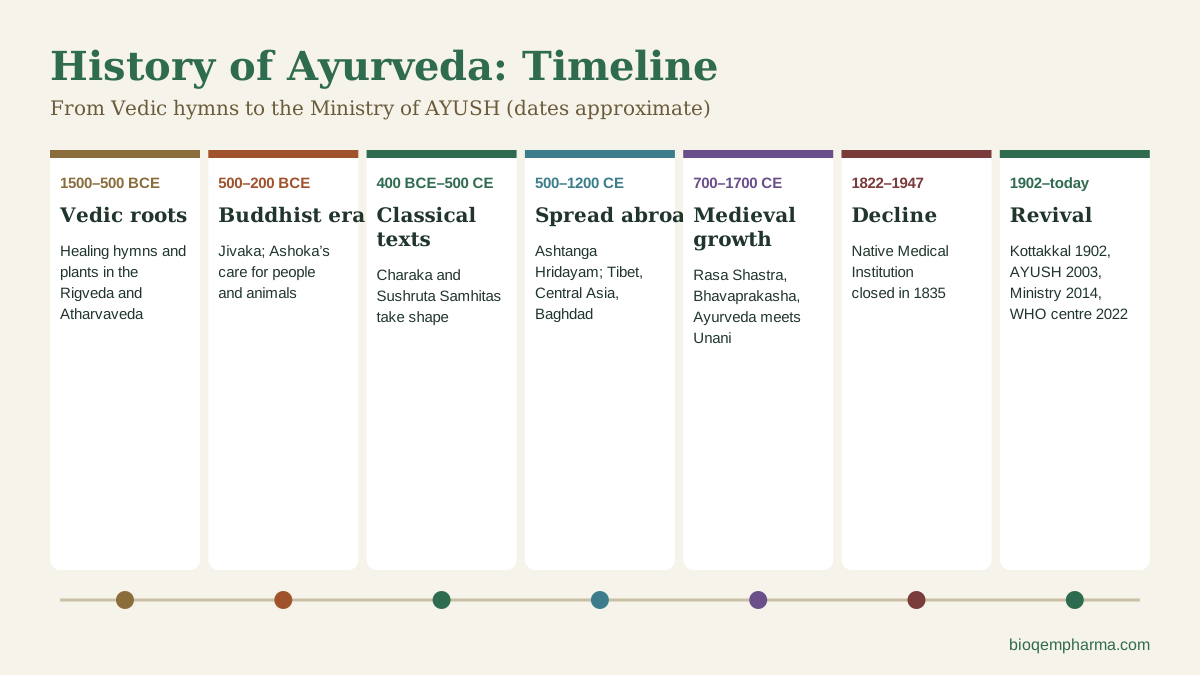
Here is the whole Ayurveda timeline in one table. Dates for ancient texts are approximate, because scholars still debate them.
| Period | Approximate dates | What happened |
|---|---|---|
| Prehistory | About 7,500 to 9,000 years ago | People at Mehrgarh (in today’s Pakistan) drilled teeth with flint tools. This is early healing, not yet Ayurveda. |
| Vedic period | About 1500 to 500 BCE | Healing hymns and plant knowledge appear in the Rigveda and the Atharvaveda. |
| Buddhist era | About 500 to 200 BCE | Physicians like Jivaka. Emperor Ashoka (268 to 232 BCE) arranges medical care for people and animals. |
| Classical era | About 400 BCE to 500 CE | The Charaka Samhita and Sushruta Samhita take shape in layers. |
| Early medieval | About 500 to 700 CE | The Bower Manuscript (500 to 550 CE). Vagbhata writes the Ashtanga Hridayam. |
| Spread abroad | About 700 to 1200 CE | Translations into Arabic, Persian and Tibetan. Indian doctors work in Baghdad. |
| Medieval India | About 700 to 1700 CE | Madhava Nidana, Sharangadhara Samhita, Bhavaprakasha. Rasa Shastra grows. Unani arrives and both systems live side by side. |
| Colonial period | 1757 to 1947 | Native Medical Institution opens in 1822 and closes in 1835. Ayurveda loses state support. |
| Revival | Late 1800s to 1947 | New Ayurvedic schools and pharmacies, such as Arya Vaidya Sala, Kottakkal (1902). |
| Independent India | 1947 to today | Central Council of Indian Medicine (1971), Department of AYUSH (2003), Ministry of AYUSH (2014), WHO centre in Jamnagar (2022). |
Keep this table in mind. The rest of this article walks through each row, one era at a time.
Myth or history? How old is Ayurveda really?
Ayurveda has two stories of its age: a traditional one and a historical one. Both are worth knowing, as long as we keep them apart.
The traditional story
The Charaka Samhita describes a chain of teachers. Knowledge passed from Brahma (the creator) to Daksha Prajapati, then to the Ashvini Kumaras (the twin divine physicians), then to Indra. The sage Bharadvaja learnt it from Indra and brought it to earth. His student Atreya Punarvasu then taught six disciples: Agnivesha, Bhela, Jatukarna, Parashara, Harita and Ksharapani.
Another tradition honours Dhanvantari, the god of medicine, who rose from the churning of the ocean holding a pot of amrit (nectar). In the Sushruta tradition, Dhanvantari appears on earth as Divodasa, king of Kashi, who teaches surgery to Sushruta.
This is why many people say Ayurveda is “5,000 years old”. It is a statement of faith and tradition.
The historical story
Historians look for written and physical evidence. They find medical ideas in the Vedas, and Ayurvedic terms in Buddhist texts from around the middle of the first millennium BCE. The great Ayurvedic books reached their present shape between about the last few centuries BCE and 500 CE.
So the honest answer is this. The roots of Ayurveda are very old, perhaps older than 3,000 years. The organised system we study today was written down over many centuries, and it kept growing after that.
| Common claim | What the evidence says |
|---|---|
| “Ayurveda is exactly 5,000 years old.” | This comes from tradition. Written texts are younger, but the ideas are older than the books. |
| “Charaka wrote his whole book alone.” | Charaka revised Agnivesha’s older work. Dridhabala later rewrote about one-third of it. |
| “Ayurveda never changed.” | It changed a lot. Later books added new herbs, pulse reading and even new diseases. |
| “Ayurveda is only for India.” | Its books were translated into Tibetan, Arabic, Persian and Chinese more than 1,000 years ago. |
What is the origin of Ayurveda in the Vedas?
The origin of Ayurveda lies mainly in the Vedas, the oldest sacred books of India. Ayurveda is often called an upaveda (a supporting branch) of the Atharvaveda.
The Rigveda already praises healing plants and the Ashvins as divine doctors. The Atharvaveda goes further. It has many hymns and prayers to remove fever, cough, skin trouble and worms, and it names a large number of plants.
At this stage, healing mixed prayer, charms and herbs. A person with fever might receive a plant remedy and a chanted hymn together. Over time, Indian physicians began to separate careful observation from ritual. That shift is the true birth of Ayurveda as a system.
Was there healing before the Vedas?
Yes, people in South Asia practised some kind of healing long before. In 2006, scientists reported in the journal Nature that people at Mehrgarh had drilled holes in living people’s teeth between 7,500 and 9,000 years ago. Researchers found 11 drilled molars from 9 adults.
This does not prove Ayurveda existed then. It does show that the region had a very long tradition of trying to heal the body.
The Buddhist era: who were the early teachers?
The Buddhist era (about 500 to 200 BCE) gave Ayurveda some of its first real-life heroes. Many historians, such as Kenneth Zysk, believe wandering monks and healers of this time helped shape Ayurveda’s practical, observation-based style.
Jivaka, the Buddha’s physician
Buddhist texts describe Jivaka Komarabhacca, a doctor who lived around the 5th century BCE. According to these texts, he studied medicine for seven years at Takshashila (Taxila), a famous centre of learning. He became physician to King Bimbisara and to the Buddha himself.
A popular story says his teacher asked him to bring back any plant that had no medical use. Jivaka searched for days and returned empty-handed. Every plant, he said, had some use. Whether or not it happened exactly so, the story shows how much early physicians valued plant knowledge.
Ashoka’s hospitals for people and animals
Emperor Ashoka ruled from about 268 to 232 BCE. His Rock Edict II, carved in stone, says he arranged two kinds of medical care: for humans and for animals. He also had medicinal plants and roots planted wherever they were not available.
This is one of the oldest written records of public health care anywhere in the world. Great monastery universities such as Takshashila and, later, Nalanda also taught medicine alongside other subjects.
What are the ancient texts of Ayurveda?
The ancient texts of Ayurveda are long Sanskrit books called samhitas (collections). The three most important are called the Brihat Trayi (the great three). Interestingly, this grouping name only became common around 1900, but the books themselves are many centuries older.
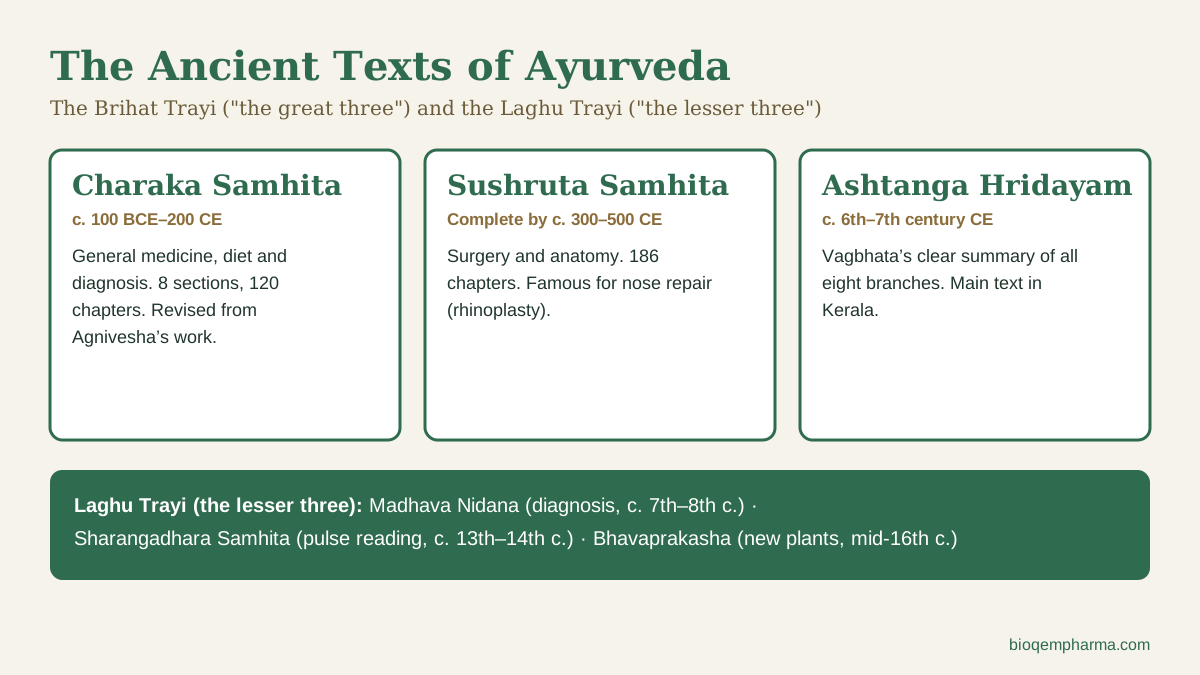
| Text | Approximate date | Main focus | Size |
|---|---|---|---|
| Charaka Samhita | About 100 BCE to 200 CE (revised later) | General medicine, diet, diagnosis | 8 sections, 120 chapters |
| Sushruta Samhita | Layers from late BCE, complete by about 300 to 500 CE | Surgery, anatomy, eye and ENT care | 186 chapters in 6 books |
| Ashtanga Hridayam | About 6th to 7th century CE | A neat summary of all 8 branches | 6 sections, 120 chapters |
Charaka Samhita: the book of medicine
The Charaka Samhita began as a book by Agnivesha, a student of Atreya. Charaka revised it, probably between 100 BCE and 200 CE, and it took his name. Centuries later, a scholar named Dridhabala completed it. He wrote about one-third of the book himself, because that portion had been lost.
The book has 8 sections and 120 chapters. It covers causes of disease, diagnosis, food, seasons, medicines and the duties of a good doctor. It even describes how a medical student should be tested and how a physician should behave with patients.
Everyday example: Charaka describes daily habits such as cleaning the teeth, oiling the body and eating at the right time. Many Indian families still follow some of these habits without knowing where they came from.
Sushruta Samhita: the book of surgery
The Sushruta Samhita is famous for surgery. Its present form grew in layers, and it was likely complete by about 300 to 500 CE. The oldest surviving manuscript of it dates to 878 CE.
The text describes about 1,120 illnesses, 700 medicinal plants and many surgical tools and methods. It explains procedures such as removing stones, setting bones and repairing the nose and ear. Its cheek-flap method of rebuilding a nose is still known to plastic surgeons today. That is why Sushruta is often called the “father of surgery”.
This fame has a modern twist. In 1794, a London magazine reported an Indian method of nose repair seen in Pune. That report helped spark interest in plastic surgery in Europe.
Ashtanga Hridayam: the handy summary
Vagbhata wrote the Ashtanga Hridayam (the heart of the eight branches) around the 6th to 7th century CE. He also wrote a larger work, the Ashtanga Sangraha. The Hridayam blends the ideas of Charaka and Sushruta into clear, easy-to-memorise verses.
In Kerala, the Ashtanga Hridayam became the main text for traditional physician families known as Ashtavaidyas. It was also translated into Tibetan, Arabic and Persian.
Other early texts
- Bhela Samhita: written by another student of Atreya. Only part of it survives.
- Kashyapa Samhita: an early book focused on children’s health, pregnancy and women’s care.
- The Bower Manuscript: a birch-bark book found in 1890 near Kucha, in western China. It is dated to about 500 to 550 CE. One part praises garlic in 43 verses.
The Laghu Trayi: the lesser three
Later scholars added three shorter but important books, called the Laghu Trayi (the lesser three):
- Madhava Nidana (around the 7th to 8th century CE): a book only about diagnosis, still used to study the signs of disease.
- Sharangadhara Samhita (around the 13th to 14th century CE): known for medicine-making methods and for describing nadi pariksha (pulse reading).
- Bhavaprakasha by Bhavamishra (mid-16th century CE): a large book that added many new plants and foods.
What are the eight branches of Ayurveda?
Ayurveda has eight branches, called Ashtanga Ayurveda (eight-limbed Ayurveda). The list appears even in the Mahabharata, and all the classical books follow it. You can think of them as the “departments” of an ancient hospital.
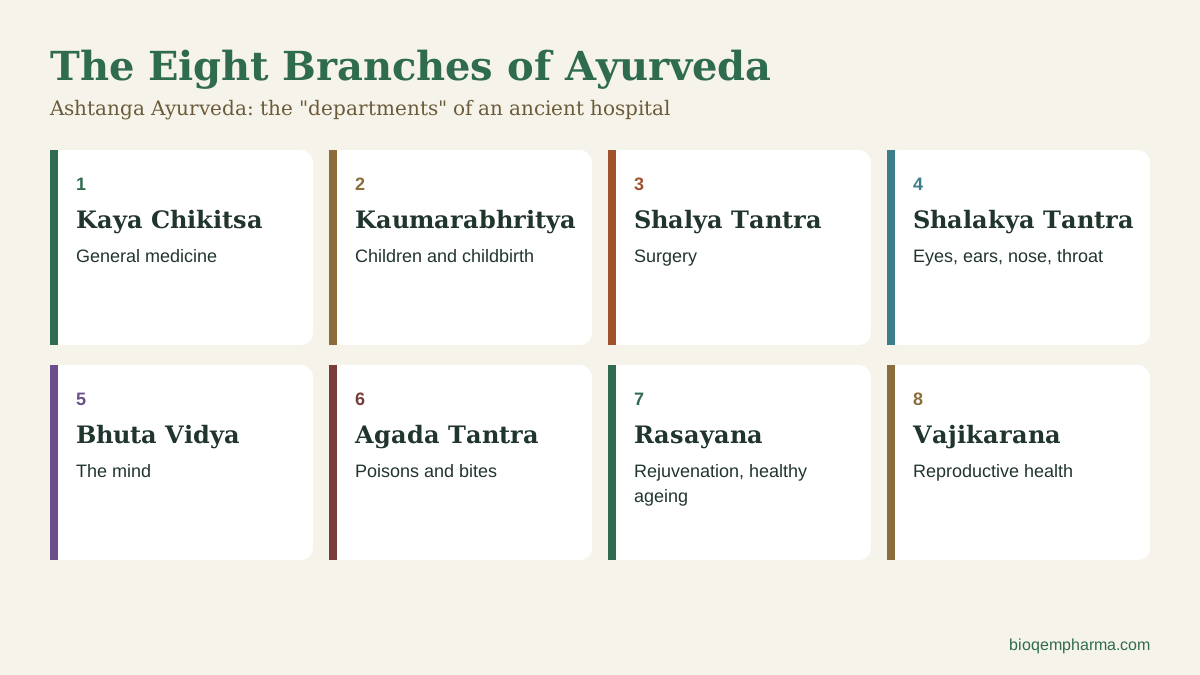
| Branch (Sanskrit) | Simple meaning | Modern comparison |
|---|---|---|
| Kaya Chikitsa | Care of the whole body | General medicine |
| Kaumarabhritya (Bala) | Care of babies and children | Paediatrics and childbirth |
| Shalya Tantra | Surgery and removing foreign objects | Surgery |
| Shalakya Tantra | Eyes, ears, nose, mouth and head | ENT and eye care |
| Bhuta Vidya (Graha) | Disorders of the mind | Psychiatry |
| Agada Tantra | Poisons and bites | Toxicology |
| Rasayana | Rejuvenation and healthy ageing | Geriatrics and wellness |
| Vajikarana | Reproductive health | Reproductive medicine |
What stands out is how complete this list is. More than 2,000 years ago, Indian physicians already thought about children, the mind, poisons and old age as separate fields.
How did Ayurveda spread across Asia and to Baghdad?
Ayurveda spread mainly with Buddhist monks, traders and scholars. Its books travelled along the Silk Road and by sea.
Tibet, Central Asia and China
The Bower Manuscript, found in western China, shows that Ayurvedic texts were carried far from India by the 6th century CE. The Ashtanga Hridayam was translated into Tibetan, and Tibetan medicine shares many ideas with Ayurveda. The Kashyapa Samhita was translated into Chinese during the Middle Ages.
Sri Lanka and Southeast Asia
Ayurveda also reached Sri Lanka, Nepal and parts of Southeast Asia. Sri Lanka still has its own strong Ayurvedic tradition, called Deshiya Chikitsa alongside classical Ayurveda.
Baghdad and the Arab world
One of the most surprising chapters in the history of Ayurveda happened in Baghdad. In the late 8th century, the Barmakid family, ministers at the court of Caliph Harun al-Rashid (786 to 809), invited Indian physicians to the city.
- An Indian doctor named Manka is said to have treated the Caliph and translated an Indian medical book.
- Ibn Dhan, another Indian physician, ran a hospital in Baghdad.
- The Sushruta Samhita was translated into Arabic in this period. The Charaka Samhita was translated into Persian and Arabic in the 9th century.
- The famous Persian doctor Al-Razi (about 865 to 925 CE) quoted Indian sources in his huge medical encyclopedia.
So Indian ideas flowed into Arabic medicine, which later shaped Unani medicine. Centuries later, Unani came back to India. History often runs in circles like this.
Medieval India: new books, new diseases and Unani
Medieval India (about 700 to 1700 CE) was a busy time for Ayurveda. Scholars wrote commentaries, new branches grew, and Ayurveda met a new system: Unani.
Great commentators
Ayurveda kept its old books alive by explaining them. Chakrapani Datta wrote a famous commentary on the Charaka Samhita in the 11th century. Dalhana wrote the earliest surviving full commentary on the Sushruta Samhita around 1200 CE. Students still read these commentaries today.
Rasa Shastra: medicine with minerals
From around the 8th century, a branch called Rasa Shastra (the science of minerals) grew fast. It used carefully processed metals and minerals, especially mercury, in medicines. The name Nagarjuna is linked with this tradition, though several people carried that name.
Rasa Shastra shows Ayurveda’s inventive side. It also raises a modern lesson: mineral medicines need strict processing and testing. We come back to this below.
Ayurveda kept updating: the story of “Phiranga roga”
Here is a fine example that Ayurveda was not frozen in time. After Portuguese traders reached Calicut in 1498, a new disease spread in Indian port towns. In the mid-16th century, Bhavamishra described it in the Bhavaprakasha as phiranga roga, “the disease of the foreigners”. Today we know it as syphilis.
The Bhavaprakasha also lists new plants that had recently come into India. In other words, Ayurvedic writers watched the world around them and kept adding to their books.
Ayurveda meets Unani
Unani medicine (Greek-Arabic medicine, from “Yunan”, meaning Greece) arrived in India with the Delhi Sultanate and grew under the Mughals. Ayurveda and Unani lived side by side for centuries. Royal courts supported physicians of both systems.
The two systems also learned from each other. Ayurvedic books were translated into Persian, such as the Ma’dan al-Shifa-i Sikandar Shahi (around 1512). Many Indian herbs entered Unani, and many Unani preparations became familiar across India.
At Bioqem Pharma, we make both Ayurvedic and Unani products, so this shared history is close to our own work. You can read how the two systems differ in our coming guide on Unani and Ayurveda.
Why did Ayurveda decline under British rule?
Ayurveda declined under British rule mainly because it lost state support and official recognition. Western medicine became the only system backed by colleges, jobs and law.
The turning point came in Kolkata. In 1822, the East India Company opened the Native Medical Institution. There, students learned both European and Indian medicine, in English and Indian languages. In 1835, the Institution was closed and replaced by the Calcutta Medical College, which taught only Western medicine.
Over the next century, the effects added up:
- Government jobs and hospitals went only to doctors trained in Western medicine.
- Traditional teachers lost students and income.
- Many manuscripts were lost, damaged or left unread.
- Ayurveda survived mostly in families, village practice and some royal courts.
Still, Ayurveda never disappeared. Ordinary people kept using home remedies, herbs and daily routines learned from their grandparents.
How was Ayurveda revived?
Ayurveda was revived from the late 1800s by physicians, scholars and the freedom movement. They opened modern-style schools, printed old texts and started organised pharmacies.
- Printing the classics: Sanskrit texts were edited and printed, so students no longer depended on rare palm-leaf manuscripts.
- New colleges: Ayurvedic colleges opened in many cities, mixing classical study with subjects like anatomy.
- Organised medicine-making: On 12 October 1902, Vaidyaratnam P. S. Varier founded the Arya Vaidya Sala at Kottakkal, Kerala. It began as a small clinic and pharmacy and became one of India’s best-known Ayurvedic institutions.
- National pride: During the freedom struggle, many leaders saw Ayurveda as part of India’s heritage worth protecting.
This revival changed how Ayurvedic medicines were made. Instead of a single vaidya (Ayurvedic doctor) preparing medicine at home, factories began making standard products. That shift continues today, with modern quality testing added.
Ayurveda today: from AYUSH to the WHO
Today, Ayurveda is a recognised, regulated system of medicine in India with its own ministry, colleges and research councils. Here are the main milestones since independence:
| Year | Milestone |
|---|---|
| 1971 | Central Council of Indian Medicine set up under the IMCC Act, 1970, to regulate education and practice. |
| 1995 | Department of Indian Systems of Medicine and Homoeopathy (ISM&H) created in March. |
| 2003 | Department renamed the Department of AYUSH in November. |
| 2014 | Ministry of AYUSH formed on 9 November. |
| 2016 | First National Ayurveda Day celebrated, on Dhanteras. |
| 2017 | All India Institute of Ayurveda, New Delhi, inaugurated by the Prime Minister on 17 October. |
| 2021 | National Commission for Indian System of Medicine (NCISM) replaces the old Council. |
| 2022 | India and the WHO agree to set up the WHO Global Centre for Traditional Medicine in Jamnagar, Gujarat (25 March). |
| 2025 | Government fixes 23 September as Ayurveda Day every year, instead of the changing Dhanteras date. |
The WHO notes that 170 of its 194 member states report the use of traditional medicine. Ayurveda is one of the best-known of these systems worldwide, and it is also practised in countries like Nepal and Sri Lanka.
Modern questions: evidence and safety
A modern history of Ayurveda must be honest. Researchers are still testing many traditional remedies with modern methods. For some herbs, the evidence is promising. For many others, research is limited.
Safety is the other big lesson. A 2008 study in the journal JAMA found lead, mercury or arsenic in about one in five Ayurvedic products bought online in the US. Mineral-based Rasa Shastra products were more often affected.
That is why quality testing matters so much today. At Bioqem Pharma, we make our products in our own facility in Bengaluru, and every batch is lab-tested for heavy metals and steroids. Whatever brand you choose, look for clear labels, a licence number and test reports.
What does the history of Ayurveda teach us today?
The history of Ayurveda teaches that good health starts with daily habits, and that a medical tradition stays alive only when it keeps learning. Here are five simple lessons you can use:
- Prevention first: Charaka spends many chapters on daily and seasonal routines before he discusses disease. Regular sleep, simple meals and movement are still the base of good health.
- Observe carefully: from Jivaka’s plant search to Bhavamishra’s new disease, Ayurveda grew by watching people closely.
- Keep learning: Ayurveda changed across 2,000 years. It is fair to keep testing it with modern science.
- Quality matters: Rasa Shastra shows that how a medicine is made is as important as what is in it.
- Respect both science and tradition: tradition gives us questions and wisdom. Evidence tells us what works for whom.
Example: a 45-year-old office worker reads about dinacharya (daily routine) from the Charaka Samhita. She starts sleeping by 10:30 pm and eats dinner earlier. She hasn’t taken any new medicine; she is just using one of the oldest ideas in Ayurveda.
When should you see a doctor?
History is interesting, but your health needs current advice. Please see a qualified doctor if you:
- have a fever that lasts more than three days, chest pain, or trouble breathing
- notice blood in your stool or urine, or sudden weight loss
- are pregnant, breastfeeding, or planning to give a remedy to a child
- take regular medicines for blood sugar, blood pressure, thyroid or blood thinning, before adding any herbal product
Frequently asked questions about the history of Ayurveda
Who is the father of Ayurveda?
There is no single father of Ayurveda. Dhanvantari is worshipped as the god of Ayurveda. Charaka is often called the father of Indian medicine, and Sushruta is called the father of surgery.
How old is Ayurveda?
Tradition says Ayurveda is over 5,000 years old. Its roots go back to the Vedic period, and its main books were written roughly between 400 BCE and 700 CE.
Which Veda is Ayurveda from?
Ayurveda is mostly linked with the Atharvaveda, and is often called its upaveda (supporting branch). The Rigveda also mentions healing plants and the divine doctors, the Ashvins.
Who wrote the Charaka Samhita?
Agnivesha wrote the first version, Charaka revised it between about 100 BCE and 200 CE, and Dridhabala completed it later. That is why the book is named after Charaka.
What are the three main books of Ayurveda?
The three main books are the Charaka Samhita, the Sushruta Samhita and the Ashtanga Hridayam. Together they are called the Brihat Trayi, or “the great three”.
Why did Ayurveda decline during British rule?
Ayurveda declined because the British government supported only Western medicine with colleges, jobs and law. The Native Medical Institution, which taught Indian medicine, was closed in 1835.
Is Ayurveda recognised by the WHO?
The WHO includes Ayurveda in its work on traditional medicine. It set up its Global Centre for Traditional Medicine in Jamnagar, India, in 2022, but it does not endorse every remedy.
What is the difference between Ayurveda and Unani?
Ayurveda began in India and is based on the three doshas. Unani came from Greek and Arabic medicine and is based on four humours, and the two systems have lived side by side in India for centuries.
Sources
- Narayanaswamy V. Origin and development of ayurveda: a brief history. Ancient Science of Life (PubMed).
- Charaka Samhita, Sutra Sthana, Chapter 1 (Deerghanjiviteeya Adhyaya). Charak Samhita Online.
- Coppa A. et al. Early Neolithic tradition of dentistry. Nature, 2006.
- The Edicts of Ashoka. World History Encyclopedia.
- Phiranga roga: the history of syphilis in pre-independence India. Indian Journal of Dermatology, Venereology and Leprology.
- WHO establishes the Global Centre for Traditional Medicine in India. World Health Organization, 2022.
- Govt declares 23rd September as Ayurveda Day. All India Radio News, 2025.
Keep reading
Want to see how these old ideas fit modern life? Read our article on the power of Ayurveda in modern wellness. If you’d like to see traditional Unani formulas made today, you can browse our Khamir range.
This article is for general education only. It is not medical advice and does not diagnose, treat, cure or prevent any disease. Please talk to a qualified doctor before you change your diet, routine or medicines.