Quick answer: Korean red ginseng is the root of the Panax ginseng plant, steamed and then dried. People in Korea and China have used it for hundreds of years to support energy and everyday wellness. The research is mixed, it can affect your sleep, and it can clash with some medicines. So talk to a doctor before you start.
Maybe a friend swears by it. Maybe you saw a red jar in a shop and wondered what the fuss is about. Either way, you are in the right place. This guide tells you what the herb is, what we really know about it, and how to stay safe. No hype, just plain answers.
Key takeaways
- The red and white types come from the same plant. The only difference is how the root is processed.
- It is traditionally used for energy, stress and general wellness. Proof from research is still limited.
- Trouble sleeping is the most common side effect.
- Pregnant or breastfeeding women, children, and people on blood thinners or diabetes medicine should ask a doctor first.
- A good product names the plant, the plant part, the maker and the batch.
Written by Bioqem Pharma editorial team. Last updated: 18 November 2026.
What is Korean red ginseng?
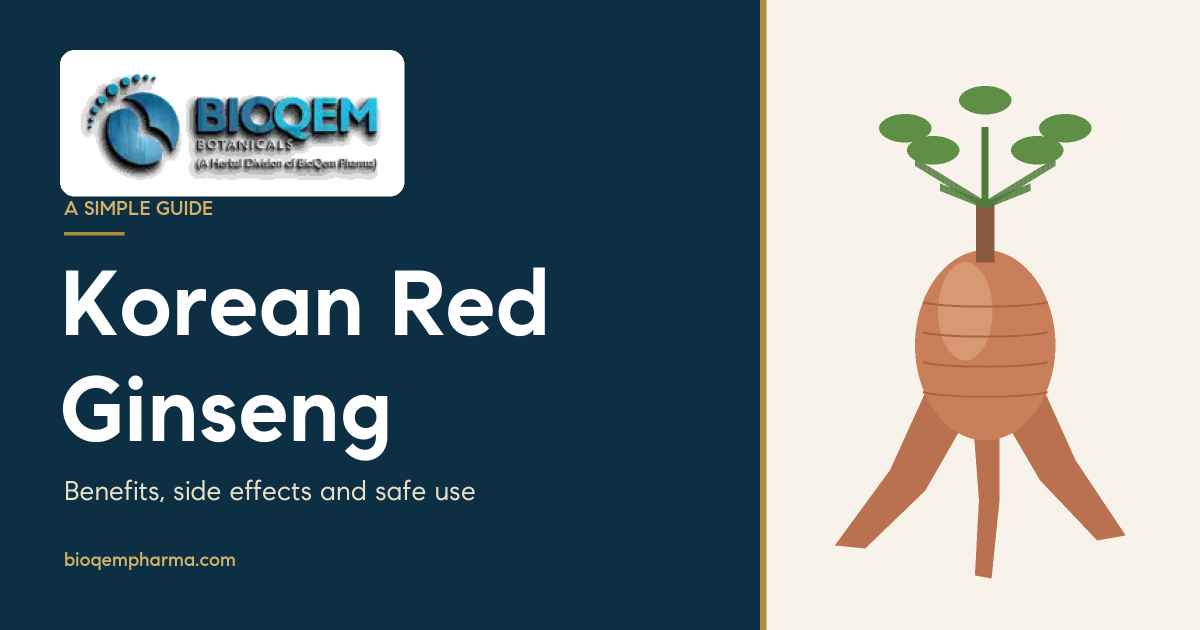
Think of it as a slow-growing root with a very long history. It comes from a plant grown mainly in Korea and China. Farmers wait for years before they dig it up. Then the fresh roots are steamed and dried, and they turn a deep reddish-brown. That is where the word “red” comes from.
The plant is also called Asian ginseng. Its scientific name starts with “Panax”, an old Greek word that means “all-healing”. Please don’t take that name as a promise. It is just a very old label.
The part we use is the root. You will find it as whole roots, slices, extract, tea, powder, tablets and capsules.
How is the red type different from the white type?
Both come from the same plant. The white type is simply air-dried. The red type is steamed first and then dried. Lab studies show that this heating changes some of the natural compounds in the root. So the two are close cousins, not twins.
| Red type | White type | |
| Plant | Same plant | Same plant |
| How it is made | Steamed, then dried | Air-dried |
| Colour | Reddish-brown | Pale cream |
| Taste | Deeper, a little bitter and sweet | Milder and earthy |
| Common forms | Extract, tea, tablets, slices | Powder, slices, capsules |
Here is a small warning. Many websites say the red type is “stronger”. Science does not give a clear yes. The two types do differ in their compounds, but nobody has shown that one is better for you.
What is inside it?
The star compounds are called ginsenosides (natural plant chemicals found in ginseng). Scientists believe most of the effects people study come from them. Steaming changes the mix of ginsenosides, which is why the two types are not identical.
There are also some sugars, minerals and fibre. But a small daily serving has very little of these. So don’t think of it as food. Think of it as a herb.
What is it traditionally used for?
In Korean and Chinese tradition, this root is used to support energy, stamina, stress and recovery after illness. Some people also take it for focus and to support the immune system.
Picture a busy office worker who feels flat by 4 pm. Or an older person slowly getting back on their feet after a long illness. These are the kind of people it has been offered to for centuries.
Please note that these are traditional uses, not proven medical claims.
Does it really work?
It may help some people feel less tired, but the proof is mixed. The honest answer is “we don’t know enough yet”.
The US National Center for Complementary and Integrative Health (NCCIH) says Asian ginseng has been promoted for stress, tiredness, thinking, flu and diabetes. For blood sugar, it says the evidence is overall inconclusive and conflicting, even after a 2022 review of 20 studies.
Why is the research so unclear? Products differ a lot. Doses differ. Many studies are small and short. So one study cannot tell you what a different product will do for you.
What forms will you see in shops?
Mostly these five:
- Extract: a thick, dark paste or liquid. You stir a small spoon into warm water.
- Tea: tea bags, dried slices or powder sachets.
- Tablets and capsules: easy to carry, with a set amount in each.
- Powder: mixed into water or food.
- Dried roots and slices: simmered in water or added to soup.
Pick the form you will really use properly. And follow the label on the pack, not a friend’s advice.
Is ginseng part of Ayurveda?
No. Ginseng belongs to Korean and Chinese medicine, not to classical Ayurveda (the traditional Indian system of health). Ayurveda has its own energy herbs.
The best known is ashwagandha. NCCIH even lists “Indian ginseng” as one of its common names. Both are called adaptogens (herbs traditionally used to help the body cope with stress). But they are different plants with different safety notes. You can read more in our Ashwagandha Ke Fayde guide, and in our guide to shilajit benefits, another traditional energy tonic. And please don’t mix herbs on your own. Ask a doctor first.
What are the side effects, and who should avoid it?
Short-term use in normal amounts seems safe for most healthy adults, says NCCIH. Long-term safety is less clear.
The most common side effect is trouble sleeping. Rare problems include a bad rash, liver injury and serious allergic reactions. Some people also get a headache or an upset stomach.
Please check with a doctor first if you:
- are pregnant or breastfeeding
- are giving it to a child
- take a blood thinner such as warfarin (ginseng may interact with it)
- take medicine for diabetes, blood pressure, cholesterol or depression
- have an autoimmune condition, since it may make it worse
- have a surgery planned
Stop and get medical help if you see a rash, swelling, yellow eyes or skin, or very dark urine.
How do you choose a genuine product?
Read the label before you read the claims. A trustworthy pack shows:
| Plant name on the label | Other roots are sold as “ginseng” too |
| Plant part: root | Leaves and stems are different |
| Amount per serving | Lets you follow the label |
| Maker name and address | A real maker tells you who they are |
| Batch number and expiry date | Links your pack to one production batch |
| Licence number (AYUSH or FSSAI) | Shows the product is regulated |
| No cure or “100% guaranteed” words | These are red flags |
Be careful with very cheap “Korean” products and with loose roots of unknown origin.
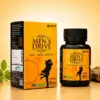
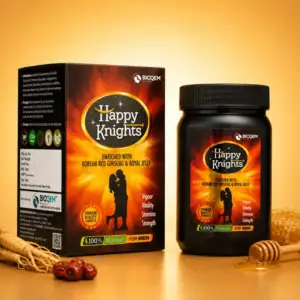
If you would like to see how we use it, we blend Korean red ginseng with shilajit, safed musli and ashwagandha in our Happy Knights Prash. Our Men’s Drive Capsules contain Panax ginseng too. Both are made in our own facility in Bengaluru. These are daily tonics, not medicines.
When should you see a doctor?
See a doctor before using ginseng if you have a long-term illness or take regular medicine. See one soon if you notice:
- tiredness that does not go away
- sudden weight loss
- a fast or uneven heartbeat
- very high or very low blood sugar readings
- a new rash or swelling after taking it
Tiredness has many causes, like poor sleep, low iron or thyroid problems. A herb will not fix those.
Frequently asked questions
Is it the same as the plant called Panax?
Yes. It is the root of that plant, steamed and dried. The plant is also called Asian or Korean ginseng.
Is the red type better than the white type?
Not proven. They come from the same plant and differ in processing and some compounds. No study has shown that one is clearly better for everyone.
Can I take it every day?
Short-term use seems safe for most healthy adults, but long-term safety is unclear. Follow the label, and ask a doctor if you want to use it for months.
Can women take it?
Many healthy women use it. But pregnant and breastfeeding women should avoid it unless a doctor says otherwise. Ask your doctor if you have a hormone-related condition.
Does ginseng affect sleep?
It can. Trouble sleeping is the most common side effect. Many people take it in the morning.
Can I take it with blood pressure or diabetes medicine?
Ask your doctor first. Ginseng may affect blood sugar and may interact with some blood pressure medicines.
Is ginseng an Ayurvedic herb?
No. It comes from Korean and Chinese tradition. Ashwagandha is the Ayurvedic herb that people often compare with it.
Can I take ginseng with ashwagandha?
Some products combine them, but you should not mix them on your own. Both can affect sleep, blood sugar or blood pressure in some people. Ask your doctor first.
Sources
- Asian ginseng: usefulness and safety, NCCIH (US National Institutes of Health)
- Herb-drug interactions: what the science says, NCCIH
- Nonpolar ginsenosides in white and red ginseng, PubMed Central
- Warfarin: precautions with herbal products, MedlinePlus
This article is for general education only. It is not medical advice and does not diagnose, treat, cure or prevent any disease. Please talk to a qualified doctor before you change your diet, routine or medicines.